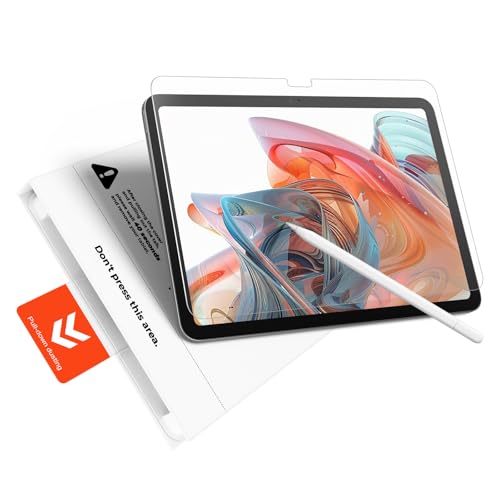
Most paper-feel advice treats the iPad line as one device. It is not. Whether your display is laminated changes how the texture looks and feels, and screen size changes what it costs you in Pencil nibs.
On a laminated display — the iPad Pro and iPad Air — the glass, touch layer and panel are bonded together with no air gap. The image sits right at the surface. Add a textured protector and the texture is optically almost in the same plane as the pixels, so the diffusion is very visible: text softens noticeably and sparkle shows clearly against white.
On a non-laminated display — the base iPad, and the mini in older generations — there is already an air gap between glass and panel. That gap produces a small parallax offset: the Pencil tip and the line it draws are visibly a fraction apart. A textured protector adds thickness on top of that, compounding a problem the laminated models do not have.
The practical consequence runs opposite to intuition. On a laminated Pro, a lighter texture is usually right, because the display is good enough that heavy diffusion is a real loss. On a non-laminated base iPad the display is already compromised, so a heavier texture costs proportionally less — but the parallax makes precision drawing harder regardless of what you fit.
Paper-feel protectors wear Apple Pencil nibs down markedly faster than bare glass, because the texture that grips the nib is abrasive. That is covered in the main paper-feel guide. What that guide cannot tell you is how fast, because it depends on the model.
Nib wear is a function of distance travelled under pressure. A 13-inch Pro invites larger strokes and more hand travel per drawing than an 11-inch, and far more than a mini. Same protector, same texture grade, materially different nib consumption.
If you draw daily on a large Pro, budget for nibs as a monthly consumable rather than an annual one, and buy a multipack up front. On a mini used for notes, the cost is close to negligible.
Nibs are not universal across the Apple Pencil range, and availability and price differ. Before committing to a textured protector, confirm which Pencil your iPad supports and that replacement nibs for it are easy to buy where you are — Best Buy, Target and Walmart all stock the common ones, but the newer types can be harder to find than the long-established ones.
Third-party nibs with harder tips exist and wear more slowly. They change the feel slightly, usually toward a firmer, less cushioned contact. On a heavily textured protector that is often a worthwhile trade.
iPad Pro (laminated, large): light texture. The display is the reason you bought it, and nib consumption at this size is the highest in the range.
iPad Air (laminated, mid-size): light to medium. The best all-round balance in the line.
Base iPad (non-laminated): medium to heavy is defensible — there is less image quality to protect — but be realistic that parallax limits precision whatever you fit.
iPad mini: texture grade barely matters for nib cost at this size. Choose on feel.
Dual-purpose device: removable magnetic, every time. It is the only option that does not force a permanent compromise.
| Model | Display | Texture we would fit | Nib cost |
|---|---|---|---|
| iPad Pro 13" | Laminated | Light | Highest — budget monthly |
| iPad Pro 11" | Laminated | Light to medium | High |
| iPad Air | Laminated | Light to medium | Moderate |
| Base iPad | Non-laminated | Medium to heavy | Moderate |
| iPad mini | Varies by generation | Any — choose on feel | Low |
Prices change daily, so the price and availability that count are always the ones shown on Amazon once you follow the link. Each item was checked individually against Amazon before publication — but read the guidance above first, because on this page the right answer is sometimes to buy nothing.

MOBDIK Paperfeel Screen Protector for iPad Air 13 & iPad Pro 13
View on Amazon →
MOBDIK Paperfeel Screen Protector for iPad A16 11th/10th & iPad Air 11
View on Amazon →
KCT 2 Pack Paperfeel Screen Protector for iPad Air 13 inch/iPad Pro…
View on Amazon →
MOBDIK Paperfeel Screen Protector for iPad 9th/8th/7th Generation
View on Amazon →
KCT 2 Pack Paperfeel Glass Screen Protector for iPad A16 11th /10th…
View on Amazon →
OMOTON PAPERSENSE Paper Screen Protector for iPad Air 13 M4/M3/M2,…
View on Amazon →Samsung flagships use ultrasonic fingerprint readers, and privacy films are the most common cause of them failing. W…
Read the guide →On a phone, a two-way privacy filter is normally enough. On an iPad the geometry of how the device is used inverts t…
Read the guide →The right answer for an Apple Watch screen protector inverts within the product line. Aluminium models use strengthe…
Read the guide →Steam Deck protectors are not interchangeable between OLED and LCD models, and some units ship with etched anti-glar…
Read the guide →The original Nintendo Switch and the Switch Lite have plastic screens that scratch far more easily than glass — incl…
Read the guide →Pro iPhones carry a LiDAR scanner in the camera module that standard models do not. A protector without the right cu…
Read the guide →The diffusion is more visible on a laminated Pro display, because the image sits right at the surface with no air gap. You notice softened text and sparkle more clearly than on a non-laminated base iPad, which already has an air gap and lower display quality.
Nib wear tracks the distance the tip travels under pressure. A 13-inch screen invites larger strokes and more hand travel per drawing than an 11-inch or a mini, so the same texture grade consumes nibs measurably faster.
Light, in most cases. The Pro display is the reason to buy that model, heavy texture costs the most image quality on a laminated panel, and nib consumption at Pro screen sizes is already the highest in the line.
Slightly. Non-laminated displays already have an air gap that separates the Pencil tip from the line it draws, and a protector adds thickness on top. Laminated models do not have this problem to begin with.