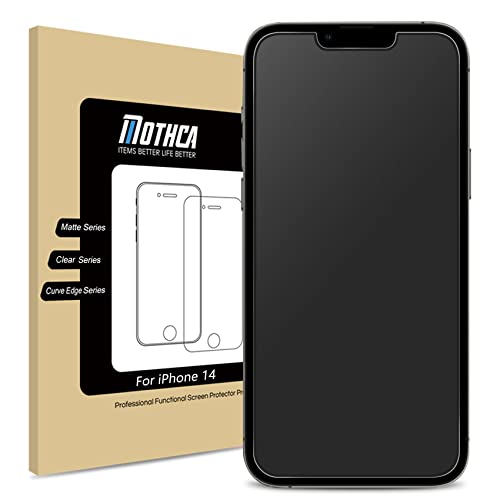
A matte protector scatters incoming light instead of reflecting it. Under bright sun that can be the difference between a readable screen and a mirror — but the same layer that scatters reflections also scatters your display.
A glossy screen bounces light back at the same angle it arrived, which is why you see a sharp reflection of the window behind you. A matte finish carries a fine surface texture that scatters that light across many angles instead.
The reflection does not disappear — it is spread out until it stops being a recognisable image and becomes a soft, even haze. That haze is much easier to see through than a mirror image of your own face.
The cost follows directly from the mechanism: the texture cannot tell the difference between light arriving and light leaving. Some of your display’s own output gets scattered too.
Scattered output shows up as a slight softening of text edges, marginally less saturated colour, and a fine glitter on large white areas often called sparkle or grain.
Here is the counter-intuitive part: sparkle is more visible the better your display is. The effect comes from interference between the protector’s texture and the pixel grid beneath it, so a dense, high-resolution flagship panel shows it more clearly than a mid-range screen. Buyers who upgrade phones and reuse their matte habit are often surprised by this.
You use the device outdoors. The strongest argument, and largely unanswerable — no glossy protector solves direct sunlight.
You game. A finger glides noticeably better across a matte surface than polished glass, particularly with a slightly damp hand. This is why matte protectors are marketed as “gaming”.
You use a stylus. The texture adds paper-like friction and control. If this is your main reason, read our paper-feel guide instead — it is the same idea taken further, with a nib-wear cost attached.
Fingerprints bother you. They still form; the diffuse surface just makes them almost invisible.
Do not put a matte protector on a device whose display was a selling point. HDR video, photography, anything where colour and fine detail matter — all are measurably degraded, and you paid for exactly the quality you would be giving up.
It also makes little sense on a tablet used mostly indoors for video, where there is no glare problem to solve in the first place.
If your issue is glare in one specific place rather than everywhere, a matte protector is a permanent fix to an occasional problem. Moving the screen, or turning up brightness, costs nothing.
| Matte / anti-glare | Glossy | |
|---|---|---|
| Reflections | Diffused into soft haze | Sharp mirror image |
| Outdoor readability | Much better | Poor in direct sun |
| Sharpness | Slightly softened | Unaffected |
| Colour saturation | Slightly reduced | Full |
| Sparkle on white | Present, worse on dense panels | None |
| Fingerprints | Nearly invisible | Very visible |
| Stylus feel | Good friction | Slippery |
Prices change daily, so the price and availability that count are always the ones shown on Amazon once you follow the link. Every item below was checked individually against Amazon.ca before this page was published.

Mothca Matte Glass Screen Protector for iPhone 17e / iPhone 16e /…
View on Amazon →
Mothca Matte Glass Screen Protector for iPhone 16 / iPhone 15…
View on Amazon →
Mothca 2 Pack Matte Glass Screen Protector for iPhone 17 Pro + 2 Pack…
View on Amazon →
Mothca 2 Pack Matte Glass Screen Protector for iPhone 17 + 2 Pack…
View on Amazon →
Mothca 2 Pack Matte Glass Screen Protector for iPhone 16 + 2 Pack…
View on Amazon →
Mothca Matte Glass Screen Protector for iPhone 14 Anti-Glare &…
View on Amazon →
Mothca 2 Pack Matte Glass Screen Protector for iPhone 15 + 2 Pack…
View on Amazon →
Supershieldz Anti Glare Screen Protector Designed for iPhone 17e, 16e,…
View on Amazon →A buyer’s guide to tempered glass screen protectors in Canada: what the glass actually does, why every listing claims …
Read the guide →How privacy screen protectors work, how much brightness they take away, and when they are the wrong choice. Written fo…
Read the guide →Paper-feel iPad protectors add friction that makes the Apple Pencil feel like a pencil. They also wear nibs down marke…
Read the guide →Liquid glass protectors are a nanometre-scale silica coating. What they genuinely do, why they cannot provide impact p…
Read the guide →Blue light screen protectors filter part of the visible spectrum. What the research says about eye strain and sleep, w…
Read the guide →Camera lens protectors prevent scratches on a module that is expensive to repair. They also add a reflective surface i…
Read the guide →It softens text slightly, reduces colour saturation a little, and adds a fine sparkle on white backgrounds. In exchange, reflections and fingerprints largely disappear. Which matters more depends on where you use the device.
Because sparkle comes from interference between the protector’s texture and the pixel grid underneath. The denser the display, the more visible the effect — so a recent flagship shows it more than an older mid-range phone.
Related but not identical. Paper-feel protectors are matte protectors with a much heavier texture, tuned for stylus friction. They give more drawing feedback and cost more image quality — and they wear stylus nibs down considerably faster.
Usually on optical sensors, less reliably on ultrasonic ones. Check that the listing names your exact model rather than making a generic compatibility claim.