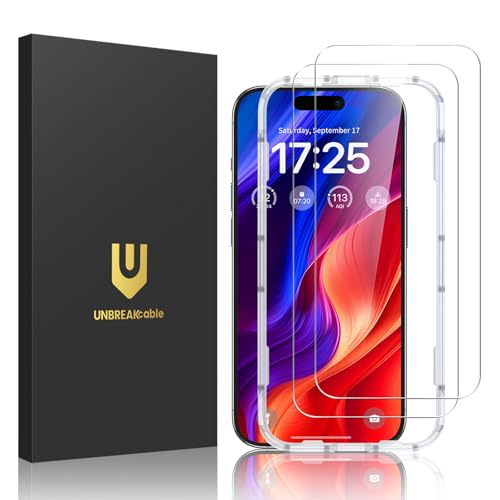
Tempered glass is the right default for most flat-screen phones and tablets. It is also the category where the marketing is least useful — every listing claims the same hardness figure, and that figure does not mean what most buyers think.
A tempered glass protector is not simply a thin sheet of window glass. It is chemically strengthened: the glass is bathed in a molten potassium salt, and the larger potassium ions swap places with smaller sodium ions near the surface. Those oversized ions crowd the surface layer into permanent compression.
That compressive layer is what does the work. A crack has to overcome the compression before it can propagate, so the glass takes a meaningful impact and then — when it finally fails — fails all at once, spreading the energy across the whole sheet instead of concentrating it on your display. A protector that has shattered into a spiderweb has just done exactly what you paid for.
It is also why a tempered protector cannot be cut or trimmed to fit. Cutting breaches the compression layer and the sheet falls apart. Buy the exact model, or do not buy.
Thickness you can feel. A glass protector adds 0.25 to 0.33 mm. On a phone that is barely noticeable; under a stylus, or on a device with edge-swipe gestures, it is.
It is consumable. Glass takes the scratch instead of your screen, which means it accumulates damage and needs replacing. Budget for that rather than treating it as a one-time purchase.
It fights curved edges. On a phone with meaningfully curved glass, a flat tempered sheet either stops short of the edge or lifts along it. Flexible film is the better answer there — see our glass vs film comparison.
Since every listing claims 9H, ignore it and compare these instead.
Every product in this category advertises “9H hardness”, which makes it useless for choosing between them. It is also widely misunderstood: 9H is a pencil-hardness grade, not a position on the Mohs scale. It means the surface resists the hardest graphite pencil in a standard test set.
On the Mohs scale that actually predicts scratching, this glass sits around 6. Quartz — the main ingredient of sand and a good share of household dust — sits at 7. That is why beach trips scratch protectors, and why keys and coins, which are far softer, never did.
We unpack this properly in the 9H hardness guide.
A foldable’s inner screen. Never. The inner panel is flexible plastic; glass cracks on the first fold and can take the display’s top layer with it. Flexible film only.
A watch with sapphire crystal. Sapphire is far harder than protector glass. Covering it swaps a highly scratch-resistant surface for a less resistant one.
An E Ink reader. A glossy sheet over a matte, low-contrast display undermines the readability that is the entire point of the device.
| Specification | Good | Avoid | Why it matters |
|---|---|---|---|
| Adhesive | Full surface | Edge-only / dot matrix | Air gaps cause rainbow shimmer and break fingerprint sensors |
| Thickness | 0.25–0.33 mm | Over 0.4 mm on ultrasonic phones | Thick glass attenuates the ultrasonic pulse |
| Edges | 2.5D rounded | Square cut | Square edges chip and catch on cases |
| Coating | Named oleophobic layer | Unspecified | Determines feel and cleanability after month three |
| In the box | Alignment frame, 2-pack | Glass only | Most failures are fitting errors, not material |
Prices change daily, so the price and availability that count are always the ones shown on Amazon once you follow the link. Every item below was checked individually against Amazon.ca before this page was published.

amFilm Auto-Alignment OneTouch for Nintendo Switch 2 Screen Protector…
View on Amazon →
Ailun 2Pack Screen Protector for iPad A16 2025 11th 11"/10th Gen 2022…
View on Amazon →
UNBREAKcable 2-Pack Screen Protector for iPhone 16 Tempered Glass
View on Amazon →
HPTech Screen Protector for Apple iPhone 11/XR 6.1 inch Tempered Glass
View on Amazon →
Ailun Screen Protector + Camera Lens Protector for iPhone 13, 2+2 Pack
View on Amazon →
Ailun 2 Pack Screen Protector for iPad 9th/8th/7th, 10.2 Inch
View on Amazon →
TOCOL for iPhone 15 Screen Protector, Clear
View on Amazon →
OMOTON 3+2 Pack for Google Pixel 10 Pro Screen Protector 6.3 inch
View on Amazon →How privacy screen protectors work, how much brightness they take away, and when they are the wrong choice. Written fo…
Read the guide →Paper-feel iPad protectors add friction that makes the Apple Pencil feel like a pencil. They also wear nibs down marke…
Read the guide →A guide to matte and anti-glare screen protectors in Canada: how diffusion works, who genuinely benefits, and why the …
Read the guide →Liquid glass protectors are a nanometre-scale silica coating. What they genuinely do, why they cannot provide impact p…
Read the guide →Blue light screen protectors filter part of the visible spectrum. What the research says about eye strain and sleep, w…
Read the guide →Camera lens protectors prevent scratches on a module that is expensive to repair. They also add a reflective surface i…
Read the guide →No. Thicker glass absorbs more impact but is more noticeable under the finger, more likely to foul a case, and can stop an ultrasonic fingerprint reader working. Above roughly 0.4 mm, reading degrades on those phones.
That is an air gap between the protector and the screen, and it means the adhesive covers only the edges rather than the whole surface. It cannot be fixed by pressing; replace it with a full-adhesive protector.
It succeeded. Tempered glass is designed to take the impact and break instead of your display, spreading the energy across the sheet. Replace it and treat it as a consumable.
No. Cutting breaches the compressive surface layer that gives tempered glass its strength, and the sheet will disintegrate. Buy the exact model.