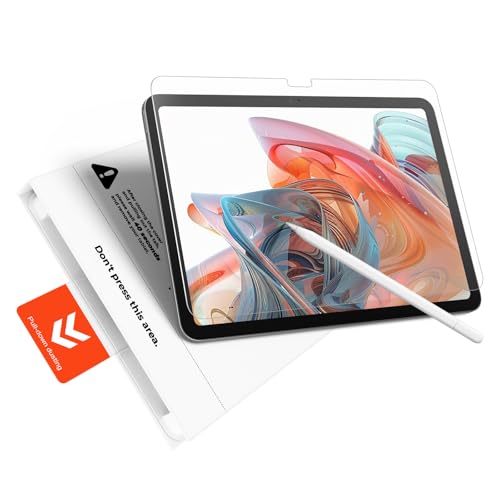
For drawing and handwriting, a paper-feel protector is one of the few accessories that genuinely changes how a device feels to use. It also has a running cost almost nobody mentions: it eats Apple Pencil nibs.
Glass is slippery. A stylus tip skates across it with almost no resistance, which is why drawing on a bare iPad feels vague — there is no feedback telling your hand where the line ends.
A paper-feel protector adds a microscopically textured surface. The nib catches very slightly on that texture, producing a faint drag and a soft audible scratch. Your hand reads that resistance as control. It is the same reason a pencil on cartridge paper feels more precise than a biro on gloss.
The texture also diffuses light, which is why every paper-feel protector is also a matte protector. The two properties are inseparable — you cannot have the friction without the diffusion.
This is the part the listings omit. The texture that grips your nib is abrasive, and the abrasion goes both ways. Apple Pencil tips that would last many months on bare glass wear visibly faster on a textured protector — heavy users commonly report replacing nibs several times more often.
A worn nib is not just shorter. It develops a flat, and the flat changes the contact patch, which changes line weight and can start to feel scratchy. Users often blame the protector for “going bad” when the nib is the part that has actually worn.
Budget for nibs before you buy the protector, and buy a multipack. Third-party nibs with harder tips exist and wear more slowly, at some cost to feel. This is a genuine ongoing expense, not a one-off.
Manufacturers sell different etch intensities, and they suit different people.
Light texture keeps more of the display’s sharpness and wears nibs more slowly, at the cost of less pronounced feedback. It is the right starting point for note-takers and anyone who also watches video on the device.
Heavy texture gives the strongest paper feel and the most control for illustration — and takes the biggest bite out of image quality and nib life. Choose it only if drawing is the primary use of the iPad.
There is also a removable magnetic format, which attaches over the display and lifts off when you want the bare screen back. It costs more and is slightly less stable under a heavy hand, but if the device is genuinely dual-purpose it solves the whole dilemma.
If the iPad is mainly for video, photos, reading or browsing, a paper-feel protector is a downgrade. You paid for a laminated, high-density display and this will visibly soften it — text edges lose crispness and a fine sparkle appears on white backgrounds, more noticeably the higher the pixel density.
Likewise if you edit photos or grade video: the diffusion shifts how colour and detail read, and you cannot trust what you are seeing.
And if you only occasionally jot a note, the honest answer is that the stock glass is fine and the nib cost is not worth it. This product is for people who draw or write on the device most days.
| Light texture | Heavy texture | Removable magnetic | |
|---|---|---|---|
| Paper feel | Subtle | Pronounced | Varies by model |
| Nib wear | Moderate | Fast | Only while attached |
| Display sharpness | Slightly softened | Clearly softened | Bare screen when removed |
| Best for | Notes, mixed use | Illustration | Genuinely dual-purpose iPads |
| Cost | Low | Low | Higher |
Prices change daily, so the price and availability that count are always the ones shown on Amazon once you follow the link. Every item below was checked individually against Amazon.ca before this page was published.

MOBDIK Paperfeel Screen Protector for iPad Air 13 & iPad Pro 13
View on Amazon →
MOBDIK Paperfeel Screen Protector for iPad A16 11th/10th & iPad Air 11
View on Amazon →
KCT 2 Pack Paperfeel Screen Protector for iPad Air 13 inch/iPad Pro 13…
View on Amazon →
MOBDIK Paperfeel Screen Protector for iPad 9th/8th/7th Generation
View on Amazon →
KCT 2 Pack Paperfeel Glass Screen Protector for iPad A16 11th /10th Gen
View on Amazon →
OMOTON PAPERSENSE Paper Screen Protector for iPad Air 13 M4/M3/M2, Matte
View on Amazon →
KCT 2 Pack Paperfeel Screen Protector for iPad Pro 12.9 Inch
View on Amazon →
bersem 2 Pack Paperfeel Screen Protector for iPad A16 11/10th & Air 11…
View on Amazon →A buyer’s guide to tempered glass screen protectors in Canada: what the glass actually does, why every listing claims …
Read the guide →How privacy screen protectors work, how much brightness they take away, and when they are the wrong choice. Written fo…
Read the guide →A guide to matte and anti-glare screen protectors in Canada: how diffusion works, who genuinely benefits, and why the …
Read the guide →Liquid glass protectors are a nanometre-scale silica coating. What they genuinely do, why they cannot provide impact p…
Read the guide →Blue light screen protectors filter part of the visible spectrum. What the research says about eye strain and sleep, w…
Read the guide →Camera lens protectors prevent scratches on a module that is expensive to repair. They also add a reflective surface i…
Read the guide →Yes, markedly. The texture that provides the drawing feel is abrasive, and heavy users typically replace nibs several times more often than on bare glass. Buy a nib multipack at the same time and treat it as a running cost.
Yes, somewhat. The same texture that adds friction diffuses light, so text is slightly less crisp and a fine sparkle appears on white backgrounds. It is more visible the higher the display’s pixel density.
Start light unless illustration is the iPad’s main job. Light keeps more image quality and wears nibs more slowly while still giving usable feedback. Heavy is for people who draw daily and accept the costs.
Removable magnetic protectors attach for drawing and lift off for video. They cost more and can feel slightly less stable under a heavy hand, but they genuinely solve the dual-purpose problem.