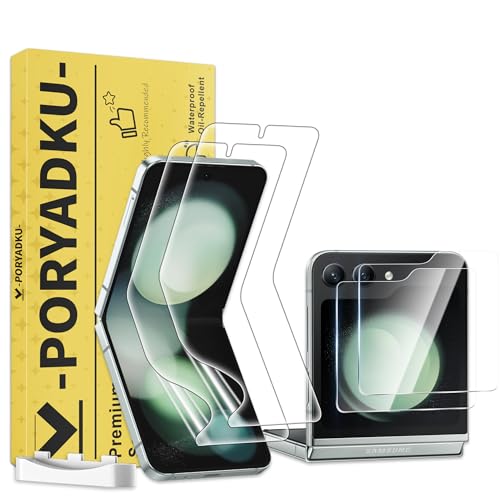
Across this whole site the default recommendation is tempered glass. On a foldable inner display that advice is not just wrong, it is destructive — and this is the only device category where we say that.
A conventional phone screen is rigid glass, and a rigid glass protector matches it. A foldable's inner display is a flexible panel with a soft polymer top layer — that softness is exactly what lets it fold tens of thousands of times.
Put a sheet of tempered glass on it and the first fold cracks the glass, because glass cannot bend. In the worst case the fracturing sheet takes the panel's polymer top layer with it, turning a bad accessory choice into a display repair.
So the entire framework reverses. Flexible film — TPU or hydrogel — is the only correct choice, and the properties we normally treat as compromises (thin, soft, scratches more easily) are here the requirements.
Foldables ship with a protective film already applied to the inner screen. It looks like the transport film you peel off a new phone. It is not. It is part of the panel's construction, and Samsung states explicitly that users should not remove it and that replacement is a service-centre job.
Peeling it off at home is the single most common cause of permanent bubbles and inner-panel damage on these devices — and because it is attributable to use rather than a manufacturing fault, it is damage a warranty is unlikely to cover.
If it lifts at an edge or gets scratched, book it in. Do not help it off with a fingernail.
The outer cover display is conventional rigid glass and should be treated exactly like any other phone: tempered glass, cut for the exact model and generation. It is worth doing, because that is the screen exposed when the device sits folded in a pocket next to keys.
Two model-specific checks. On the Flip form factor the cover screen shares its surface with the camera lenses, so the cutout has to be right for that generation — a protector for one year will not sit correctly on the next. And the protector must not stand proud of the frame, or the device will not close flat, which loads the hinge.
Expect any inner film to begin lifting along the crease eventually. That is where the material deforms most, and every fold pulls at the adhesive on that exact line. Films advertising reinforced adhesive down the central strip last considerably longer, but none last forever — treat inner films as consumable.
Fit in a humid, dust-free room. Grit trapped inside a folding device does not simply sit there; it gets pressed into a soft polymer surface every time the phone closes.
| Inner display | Cover display | |
|---|---|---|
| Material | Flexible polymer | Rigid glass |
| Tempered glass | Never — cracks on first fold | Correct choice |
| Flexible film | The only option | Unnecessary |
| Factory film | Part of the panel — leave it | Peel-off transport film only |
| Failure point | Lifting along the crease | Overhang stopping the hinge closing |
Prices change daily, so the price and availability that count are always the ones shown on Amazon once you follow the link. Each item was checked individually against Amazon before publication — but read the guidance above first, because on this page the right answer is sometimes to buy nothing.

MoShieldwish 4 Pack Screen Protectors for Samsung Galaxy Z Flip 4, 2…
View on Amazon →
MoShieldwish 4 Pack Screen Protectors for Samsung Galaxy Z Flip 5, 2…
View on Amazon →
Supershieldz Designed for Samsung Galaxy Z Flip 3 5G Screen…
View on Amazon →
Ferilinso 3 Pack Screen Protector for Samsung Galaxy Z Flip 6 / Z…
View on Amazon →
Supershieldz Designed for Samsung Galaxy Z Flip 5 Screen Protector,…
View on Amazon →
Milomdoi Screen Protector for Samsung Galaxy Z Fold 8 Ultra/Z Fold 7
View on Amazon →Samsung flagships use ultrasonic fingerprint readers, and privacy films are the most common cause of them failing. W…
Read the guide →On a phone, a two-way privacy filter is normally enough. On an iPad the geometry of how the device is used inverts t…
Read the guide →The correct paper-feel protector is not the same across the iPad line. Laminated versus non-laminated displays, scre…
Read the guide →The right answer for an Apple Watch screen protector inverts within the product line. Aluminium models use strengthe…
Read the guide →Steam Deck protectors are not interchangeable between OLED and LCD models, and some units ship with etched anti-glar…
Read the guide →The original Nintendo Switch and the Switch Lite have plastic screens that scratch far more easily than glass — incl…
Read the guide →No. Glass cannot bend, so it cracks at the first fold, and in the worst case takes the panel's soft top layer with it. The inner display takes flexible TPU or hydrogel film only.
You should not. It is part of the panel's construction rather than a transport film, and the manufacturer directs replacement to a service centre. Peeling it off at home is the most common cause of permanent bubbles and panel damage.
The crease is where the material deforms most, and every fold pulls at the adhesive along that exact line. Films with reinforced adhesive down the central strip last much longer, but inner films are consumable rather than permanent.
Ordinary tempered glass, cut for the exact model and generation. Check the camera cutout on Flip-style devices, and make sure it does not stand proud of the frame — an overhang stops the phone closing flat and loads the hinge.